Psychagogy is an ancient and rich concept whose meaning has evolved over time. Originally attested in ancient Greece, it designated a religious ceremony aimed at invoking and appeasing the souls of the dead — a practice of calling them three times by name, for the purpose of soothing or magical evocation.
Over time, the term acquired meanings closer to the guidance and direction of the mind. In medicine and psychology, psychagogy refers to the ensemble of methods concerned with directing the spirit, including the education of the will, suggestion, and even psychoanalysis. Plato, in the Phaedrus, explored the idea that true rhetoric is a form of psychagogy, fundamentally grounded in knowledge of the soul. The word itself derives from the ancient Greek psukhagôgia, from psukhê (soul) and agôgos (guide) — literally, "guidance of the soul."
Today, although the term "psychagogy" is less common than it once was (its use declined through the 1970s and 1980s), the concept endures through various modern modalities such as cognitive-behavioural therapy (CBT), life coaching, and pastoral counselling. Psychagogy may be understood as the accompaniment of the individual toward their fullness — at the heart of what they value in their inner life, their soul, or their psyche. It is recognised as one of the antecedents and constituents of modern psychology, reflecting a long history of efforts to guide individuals toward greater self-knowledge and flourishing.
Mapping the soul through history
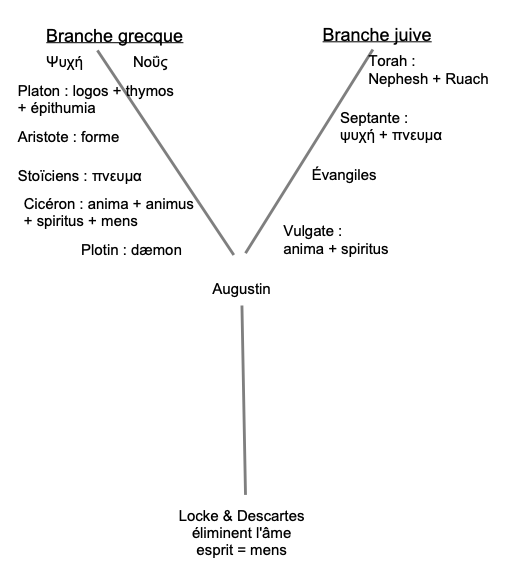
The history of the concept of the soul, or psyche, is a fascinating journey across ages and civilisations. Two great traditions of thought — the Greek branch and the Jewish branch — shaped our understanding of the inner self before converging.
Within the Greek tradition, the concept of the soul received many interpretations:
Plato conceived of it as a combination of psyché (the soul as such) and Noûs (the intellect). He divided it into three parts: logos (reason), thymos (spiritedness), and epithymia (desire).
Aristotle reduced it to form, considering it the principle that gives life and organisation to the body.
The Stoics identified it with pneuma, a vital, material, and divine breath pervading both the cosmos and the individual.
Later, Cicero defined it as a union of anima (the vital principle), animus (the rational mind), spiritus (breath), and mens (intellect).
Finally, Plotinus, the central figure of Neoplatonism, introduced the notion of the daimon — a spiritual entity and personal guide attached to each soul.
In parallel, the Jewish tradition also explored the nature of the soul.
The Torah presents it as a combination of nephesh (the vital breath) and Ruach (the divine spirit).
The Greek translation of the Bible, the Septuagint, transposed these concepts into psyché and pneuma.
The Gospels take up these notions, and the Latin translation, the Vulgate, expressed them as anima and spiritus.
These two branches of thought converged in Augustine, whose thinking profoundly shaped Western Christianity by combining Greek philosophical notions with Jewish theology. Later, Locke and Descartes marked a decisive rupture by tending to eliminate the soul, replacing it with the concept of mind or mens — referring to consciousness and rational thought. This evolution laid the foundations of modern psychology.
Our approach
Our work is rooted in a millennia-long tradition of psychagogy — the art of guiding the soul — while enriching it with a contemporary perspective. We draw on the living sources of ancient philosophy to illuminate the complexity of the human being, in particular through the emblematic figures of Lucretius and Plotinus. From Lucretius, we retain a materialist vision and a particular attentiveness to the sensations and natural movements that animate the individual. From Plotinus, we inherit the quest for inner elevation, for a transcendence of the self toward a deeper unity.
Yet our approach is not limited to these inheritances. We have observed that these philosophies, profound as they are, sometimes left open the question of an intrinsic moral or ethical conscience — beyond mere conformity to the laws of nature or aspiration toward the One. This is where psychoanalysis enters the picture, not to supplant the ancient framework but to complement and enrich it. In psychoanalysis we find the dimension of the rector: an instance that pushes us toward ethical introspection, toward confrontation with our values, and toward the regulation of our actions — an aspect less explicitly developed in the ancient systems.
Our model of the soul thus unfolds across four fundamental dimensions:
Anima — our vital and sensitive dimension, linked to emotions, perceptions, and our instinctive connection to the world.
Animus — our reflective and rational dimension, which structures our thinking, analyses, and conceptualises our experience.
Dæmon — the irrational and impulsive force, akin to the Freudian Id, which represents our deepest desires, our instinctive inclinations, and sometimes our unacknowledged drives — acting as an inner guide, at times mysterious, along our path in life.
Rector — our moral conscience, the ethical guide that prompts us to question our actions, to align our will with our values, and to seek coherence in our conduct.
By exploring these four dimensions, our test and our accompanying material offer you a unique mapping of your ipseity — helping you better understand the forces that animate you and the paths open to your personal development.