Welcome to an exploration of the human soul — not as a monolithic entity, but as a dynamic synthesis of five fundamental dimensions. This framework, inspired by the philosophies of Aristotle, Epicurus, Lucretius and Plotinus, as well as the work of Freud, offers a way to better understand our ipseity — what makes us fundamentally ourselves. By examining the interplay of animus, dæmon, rector, nexus, and anima, we can shed light on our deepest motivations, our life choices, and the sources of our inner conflicts.
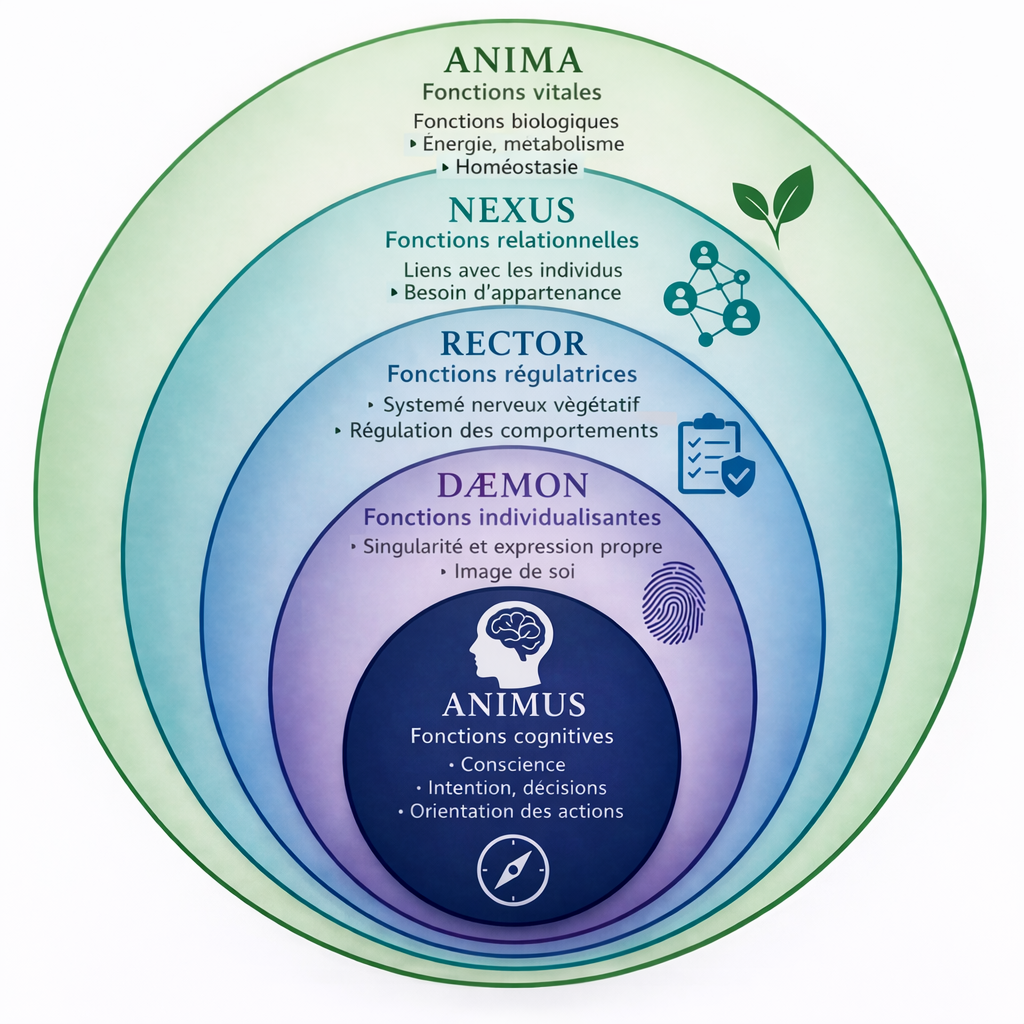
These five dimensions did not emerge all at once in the history of life. They correspond to successive strata of complexity, from the bacterium that possesses only an anima, to the human being who unites all five. This is why they can be represented as concentric circles: each outer layer presupposes and encompasses all those that precede it.
At the centre lies the animus — the rational foundation: logic, analysis, and strategy. Surrounding it, the dæmon embodies the deep call, the vocation and intuition that orient each being toward its singular flourishing. The rector then wraps the whole in a normative framework: internalised norms, sense of duty, and personal ethics. The nexus opens the being outward toward others: it is the social dimension, the capacity to form bonds, to love, to enter into partnership. Finally, the anima — the oldest and most expansive — is the very principle of life: sensation, emotion, vitality.
The animus represents the intellectual and reflective dimension of our soul. It is the seat of logic, analysis, reasoning, and the capacity to structure our thoughts. It allows us to understand the world objectively, to solve problems, to plan ahead, and to make decisions grounded in facts and deduction. The animus is our instrument for navigating the complexity of reality with clarity and precision.
The dæmon is perhaps the most enigmatic and most powerful dimension. It represents the irrational and intuitive part of our being — a force that guides us, sometimes in mysterious ways. Like Freud's id in its drive-nature, or the Islamic qarin as a spiritual companion, or Plato's daimon as a guide toward the Good and the Beautiful, our dæmon is a source of deep inspiration. It does not always act according to logic or immediate pleasure, but rather in response to an inner call aimed at our most authentic flourishing. It is the voice that urges us toward our true path, even when that path seems unreasonable to the animus or the rector.
If the dæmon is our compass toward flourishing, it is also the relentless guardian of our inner coherence. Like the mythic figure from Plato's Myth of Er, once a life path or deep identity has been "chosen" — consciously or not — the dæmon ensures we do not stray from that trajectory.
This is where its "fatal" dimension lies: the dæmon acts as a mechanism of self-justification. It locks in our past choices by pushing us to interpret reality in ways that confirm our deepest identity.
A key function of the dæmon is its role in the discovery of our vocations. Far from being a mere rational calculation (animus) or a pursuit of passing emotions (anima), the choice of a profession or a course of study is often inspired by a deep and irresistible sense of calling. It is the dæmon that whispers the path most resonant with our innate potential, orienting us toward the activity in which we can truly flourish. This is why some people feel irresistibly drawn to a particular career, even when it presents apparent challenges or constraints.
The rector is the normative dimension of the soul: it encompasses the rules, values, and sense of duty that we have progressively made our own. Close to Freud's concept of the superego, it is nonetheless distinct from the nexus in that it does not concern the bonds we form with others, but rather the norms we apply to ourselves. It is the inner voice that judges our actions, guiding us toward what we consider just and ethical, independently of the gaze of others. The rector is the guardian of our moral integrity and our personal ethical coherence.
The nexus is the social dimension of the soul. We do not live alone: we love, dislike one another, form alliances, friendships, and partnerships. This capacity to connect with others — this sense of relatedness — is a force in its own right, irreducible to the rector's morality or the animus's rationality. Close to Aristotle's theory of friendship (philia), the nexus explains why we naturally seek company, why isolation wounds us, and why certain encounters transform our lives. It is the living fabric of our belonging.
The concept of valence describes the influence of the dæmon in our interpersonal interactions. When we meet someone, it is not only our conscious personality that comes into play, but also our respective dæmons, which "recognise" one another. This invisible interaction can generate an immediate attraction or repulsion, a sense of familiarity or strangeness.
Conflicts of interest can, however, arise between dæmons. If one person's dæmon has mapped a life path fundamentally at odds with the other's, deep tensions may surface in the relationship. These divergences, often unconscious, can explain why certain relationships — despite genuine affection and effort — hit a wall of fundamental incompatibility: the respective "flourishing plans" of their dæmons are simply in disagreement.
The anima is the oldest and most universal dimension: it is present in every living being, from the bacterium to the human. It embodies the vital, emotional, and sensitive dimension of our being. It is the source of our feelings, our passions, our intuition, and our capacity to perceive the world through our senses. The anima connects us to our body, to our deepest emotions, and to our ability to feel joy, sorrow, love, or anger. It is what drives us toward artistic expression, toward a connection with nature, and toward the sensory experience of the world.
Within this model, neurosis can be understood as the manifestation of intense and prolonged internal conflicts within the soul. The most striking case is one where the rector pushes a person toward a life path — say, a settled, family-centred life — that stands in direct opposition to the deep aspirations and flourishing path mapped by the dæmon — say, an adventurous, nomadic existence.
This dissonance between what we are called to be (by the dæmon) and what we believe we ought to be (by the rector) generates psychic suffering. It may manifest as anxiety, depression, a sense of emptiness, chronic dissatisfaction, or an inability to make decisions. Resolving these neuroses requires recognising and harmonising these conflicting inner forces.
The feeling of self-esteem acts as a true barometer of the soul, reflecting our alignment with the aspirations of our dæmon and the expectations of our rector. This feeling is intimately linked to our neurochemistry — notably to the action of serotonin, which modulates the way our anima perceives our inner state.
When we manage to align ourselves with the situation inspired by our dæmon — that deep "mission" leading us toward our flourishing — and when this path is supported, or at least not hindered, by our rector, we experience a profound sense of well-being. At that moment, serotonin acts upon our anima, granting us a feeling of satisfaction, fullness, and high self-worth. It is the sensation of being exactly where we belong, of realising our potential.
Conversely, when we fail to follow this dæmonic path — or fear that we might fail — and when our existential or social security is at stake, serotonin levels may drop. The anima, under-stimulated or poorly regulated, generates unpleasant sensations. We feel miserable, weakened, and our self-esteem diminishes. This feeling, though subjective, can be a lucid signal of misalignment or genuine difficulty, prompting us to reassess our path and seek realignment.
The respective influences of the animus, the dæmon, the rector, the nexus, and the anima define our ipseity. Understanding these five dimensions and their interactions offers us a map for navigating our inner world. By consciously exploring and adjusting the weight we give to each, we have the power to sculpt our identity, resolve our inner conflicts, and align ourselves more closely with our true essence. This is not a quest for perfection, but a continuous journey toward more authentic flourishing and a deeper understanding of the self.