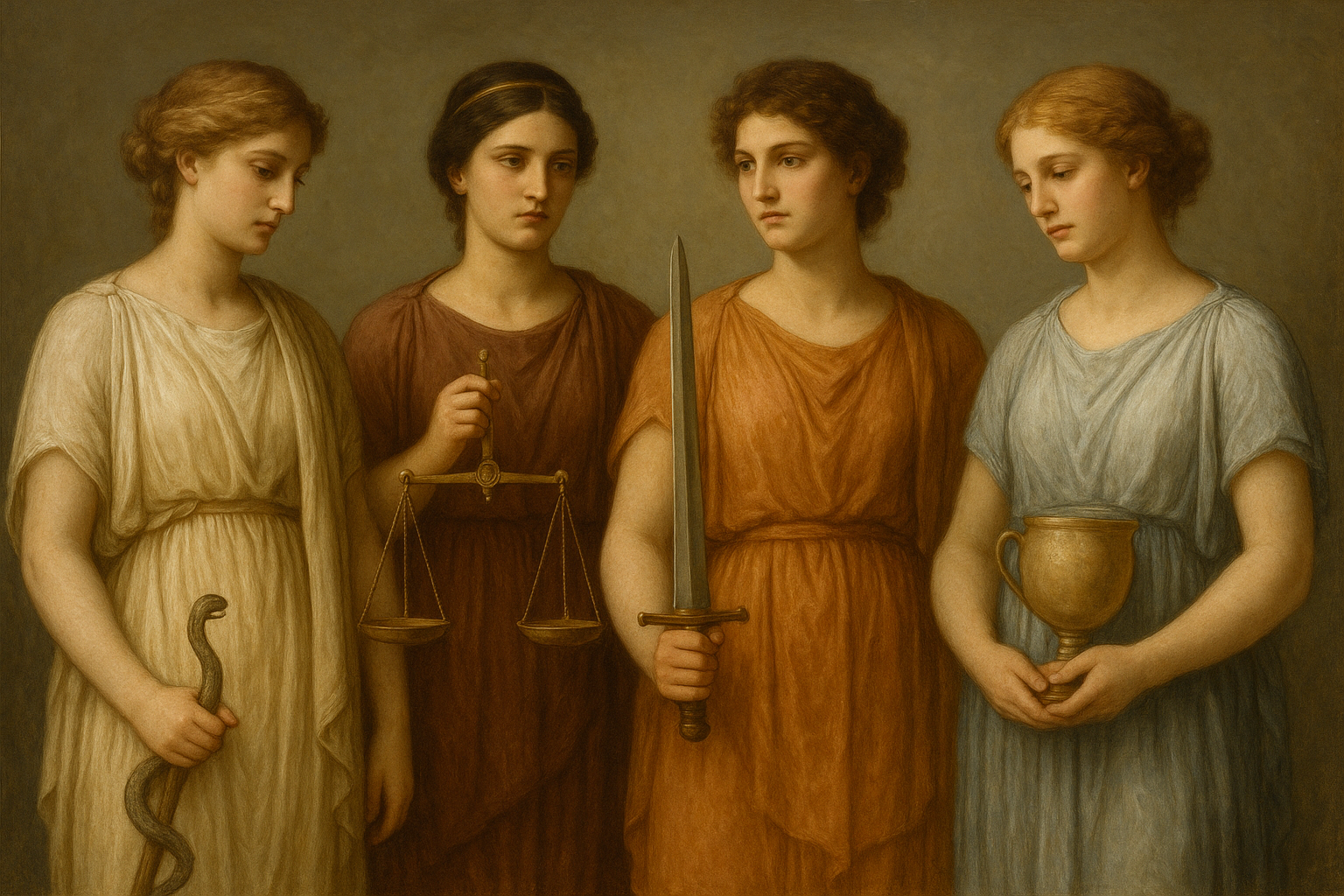
The cardinal virtues, inherited from Greek antiquity, are a cornerstone of psychagogy. Far from being mere rules of conduct, they represent an excellence of the soul (ἀρετή, aretē). They are the path by which the soul perfects itself, attains harmony, and reaches its full measure.
Where Plato conceived of them as the essential qualities of the soul — necessary to the good ordering of the inner city — Aristotle saw them as habits of behaviour (an ethics of action), more focused on social practice. This fundamental divergence is decisive: the Aristotelian approach is an ethics of conduct, while the Platonic approach, taken up by the Neoplatonists such as Sallustius (Saloustios), is an ethics of being.
Christianity, in adopting these virtues, often transformed them into moral injunctions — duties to be fulfilled for the sake of salvation. The Neoplatonic vision, however, which is more in keeping with the spirit of psychagogy, sees the virtues as inner work, a spiritual path. In the wake of Plato's Phaedrus, they constitute a perfecting of the soul in view of an "ascent" toward the divine — a quest for unity and inner truth.
Prudence is not mere caution. It is practical intelligence — the capacity to discern good from evil and to make the right decision in any given situation. It is the virtue that illuminates the soul and guides it in its quest. It enables self-knowledge and an understanding of the deeper causes behind our thoughts and actions.
Each evening, take a quiet moment for yourself, away from all distraction, and write in a notebook. Record an action or decision you made during the day. Ask yourself:
This exercise is not about judging, but about seeing. By observing what lies within our power and what does not, you sharpen your practical wisdom and reclaim sovereignty over your inner world.
Often reduced to legal justice, Justice is, for the soul, inner harmony. It is the condition in which each part of the soul — anima, animus, rector, dæmon — holds its rightful place. It represents the alignment of the being with its own ideal, its inner truth, and the rightness of its relations with the world.
Platonic justice is not primarily a social ideal but an inner state. It is the right order among the different parts of our being. When our soul is just, reason commands, courage obeys, and our desires remain in their proper place. Injustice arises when we allow our passions to seize power and disorder our being.
Imagine yourself as a citizen of an ideal city. You have a role: that of the soul which governs. In moments of turmoil — strong emotion, fatigue, desire — ask yourself:
This exercise in stepping back teaches you to recognise the forces within you and to assign each its proper role, so that your life becomes a well-governed kingdom.
Fortitude is not physical strength. It is the courage of the soul — perseverance and resilience in the face of obstacles, fears, and inner trials. It is the virtue that enables us to overcome disillusionment and acedia, and to remain faithful to our path even when doubt sets in.
Each day, choose a small situation of voluntary discomfort — physical or mental:
These exercises are not punishments but training. They strengthen the will, teach the soul not to yield at the first difficulty, and prepare it for the more significant struggles of existence.
Temperance is self-mastery — the governance of passions and desires. It is the virtue that prevents the soul from being swept away by impulse. Through the practice of temperance, the soul attains a form of serenity and balance, a state in which it can more fully devote itself to its own perfecting. It is a necessary condition for both Prudence and Fortitude.
Settle into a quiet place and focus on your sensations. Choose a simple object: a drink, a piece of bread, a breath of air on your skin.
This mindfulness exercise strengthens the capacity to detach from desires and impulses, cultivating the humility and self-command that lie at the heart of temperance.