Ψυχαγωγία
"Guiding the soul back to itself"
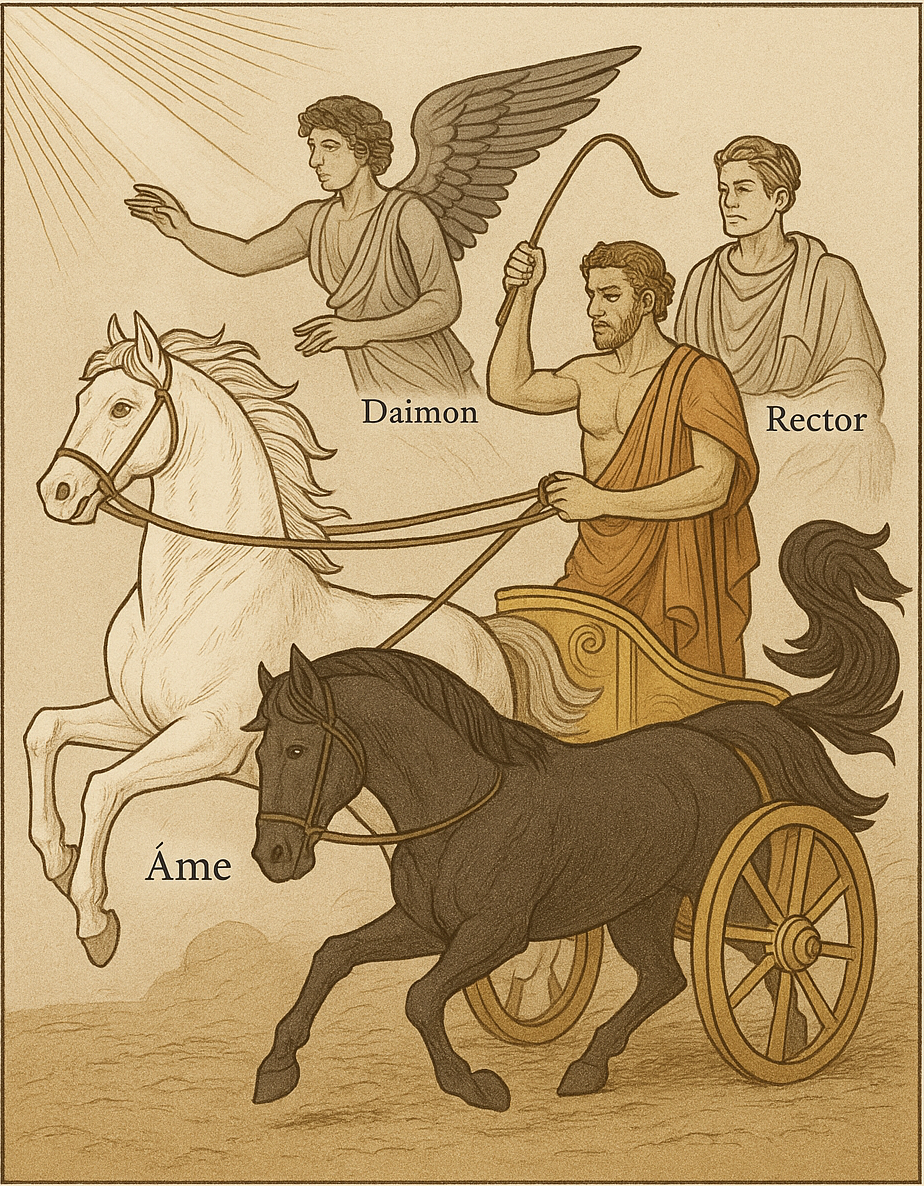
"Guiding the soul back to itself"
Psychagogy is the art of accompanying the soul in its quest for unity, truth, and kairos. Inspired by ancient traditions, it belongs neither to therapy nor to religion, but to a philosophical attention to the inner life.
"The soul must be tended through discourse" — Plato, Gorgias
Applied to F. Scott Fitzgerald's character The Great Gastby…
Psychagogy engages in dialogue with other contemporary approaches to personality. Discover how our model differs from typologies such as the MBTI, the Enneagram, or the DISC.
The term psychagogy has carried several meanings throughout history: in Plato, the power of speech to lead the soul (Phaedrus); in Christian theology, a form of spiritual edification; in modern psychology, a mode of educational accompaniment. Here we give it a contemporary usage of our own: a philosophical practice of dialogue.
Psychagogy is not therapy: it does not aim to treat a pathology or establish a diagnosis. It is not a religion: it teaches no dogma. Nor is it coaching: it does not seek to optimise performance.
It is a philosophical practice of dialogue and reflection, which helps to explore one's inner life and better understand what animates us. If some people find a greater sense of well-being through it, it is not because they have been "treated", but because they have been able to think their existence differently.
Psychagogy is a living practice rooted in a long philosophical tradition. At the heart of that tradition lie the cardinal virtues — those four qualities which, according to the Ancients, define the excellence of the soul. Far from being mere injunctions, they serve as a guide for inner work. Discover how prudence, justice, fortitude, and temperance can become the compass of your journey.
The forgetting of the soul in our culture has left room for disenchantment, loss of meaning, and inner misalignment. Psychagogy offers a path of reconciliation between the self, one's inner world, and the forces that move through us.
This inner misalignment, this loss of meaning, can manifest clinically in states such as acedia — an inner withdrawal — or burn-out, which reveals an exhaustion caused by the contradiction between our values and the demands of the outer world.
Are we imprisoned within our own representations, condemned to converse from invisible fortresses? Or is human thought, by nature, more wide-ranging than it appears?
Cognitive bubbles are neither illusions nor inevitabilities. They are horizons — necessary for thought to have a form, yet crossable once we accept that another horizon is worth approaching. Between closure and permeability, it is the thinking of the interface that makes genuine dialogue possible.
Every theory of the soul carries hidden metaphysical luggage. Freud's psyche is a closed system with no beyond. Assagioli's psychosynthesis quietly reformulates grace and salvation in therapeutic language. Neither theorist was dishonest — but both were shaped by the metaphysical bubble they inhabited.
This article names its own commitments openly: the five psychagogical forces, the Dæmon as interface with a universal consciousness field, and the simulation hypothesis as a serious philosophical framework — from Bostrom and Chalmers to Strømme's recent equations in AIP Advances.
Books (in French):
To understand how the Rector structures authority,
see: Mouton ou Rebelle (2024).
To discover how the ontology of the soul applies to organisations:
L'Âme des Entreprises (2025).
Free resource:
Download our e-book (in French) "Sommes nous des machines ?"